
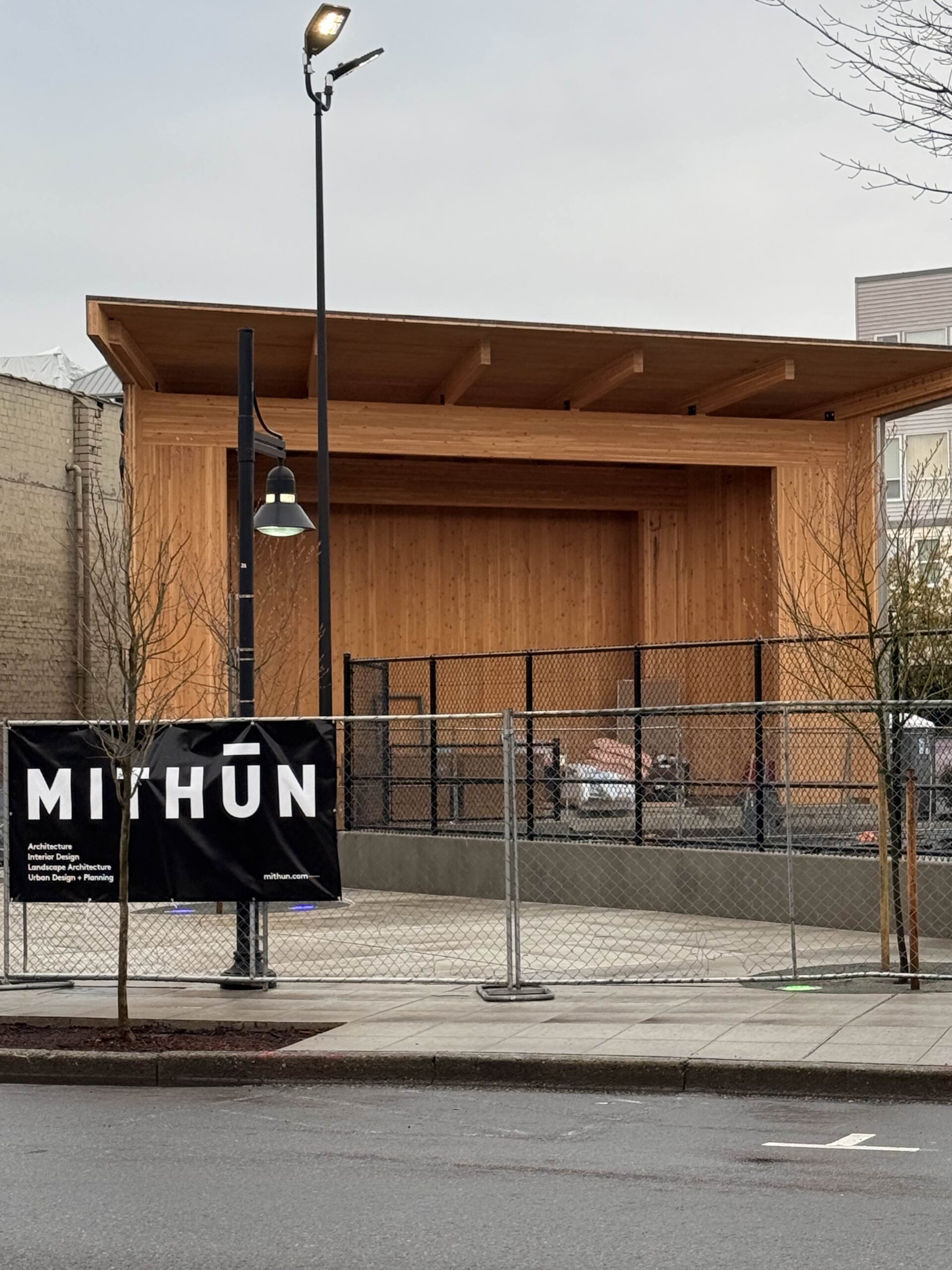
Renton, WA— Economic Development Director Amanda Free and Economic Development Manager Jessie Kotarski brought preliminary designs for two pieces of public art to Council on Monday, the first phase of artwork planned for Legacy Square. The goal was straightforward: gather feedback now so the artists can finalize their designs in time for next week’s Council meeting. Production starts May 11. The park opens June 6.
Both pieces came through a competitive selection process called a Request for Qualifications, guided by the city’s Legacy Square Art Plan. Urban Artworks, a Puget Sound nonprofit, was independently selected to coordinate both projects.
The Stage Doors: Toka Valu
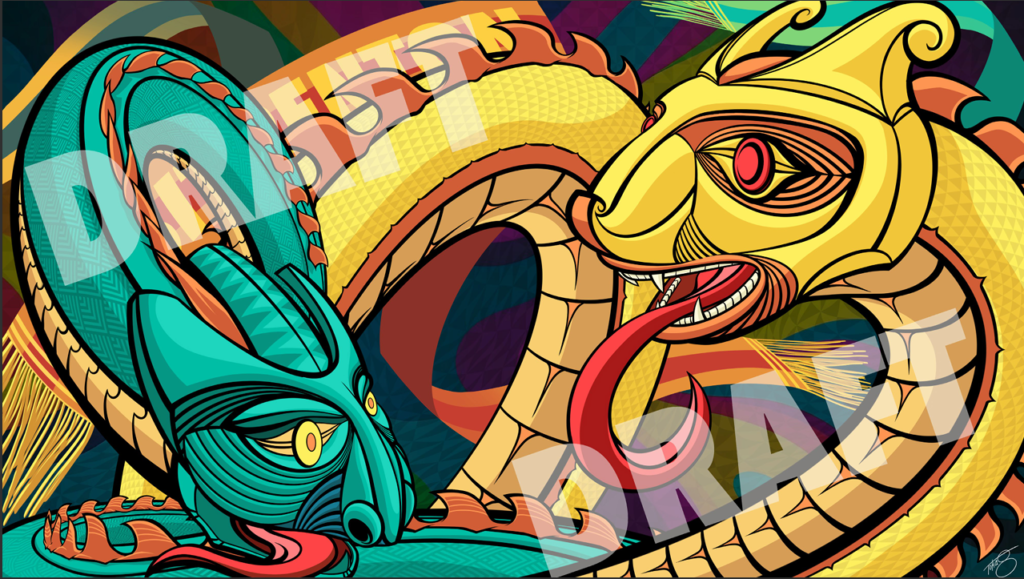
SeaTac-based artist Toka Valu’s design will be painted on the large outer doors of the Legacy Square stage— doors that, by coincidence, were installed earlier the same day. (There are two sets: an inner pair that shields the stage TV and an outer pair that gets the artwork.)
Valu’s concept features two serpents in contrasting colors, facing opposite directions. They reference the legend of the Black River— the historic river system, since drained, that early residents believed flowed in two directions depending on the season. Its Chinook Jargon name was “Mox La Push,” meaning “two mouths.” Valu draws on Coast Salish formline traditions and the carving styles of his own Tongan and Pasifika upbringing.
The Wall Mural: Nikita Ares

Nationally recognized muralist Nikita Ares is designing the mural for the wall west of Legacy Square. Her piece features a winged serpent moving through water beneath a night sky, with abstract patterns suggesting motion. The moon, on a closer look, appears to be an egg.
“What Story Are We Trying to Tell?”
Councilmember Rivera opened the discussion with a question lifted straight from the Art Plan itself: “What story are we trying to tell?” The plan’s stated goal is “a cohesive visual story reflecting Renton’s identity.” Kotarski explained that the dragon imagery emerged from community feedback gathered during planning.
That answer did not satisfy everyone.
Councilmember O’Halloran called Valu’s piece “beautiful,” but said it read as “a bit aggressive” on first impression. She pointed out that the pieces will be located close to a preschool, and wondered how young children might react. She also raised concerns about whether the two pieces would feel cohesive together.
Councilmember Alberson echoed the cohesion concern more sharply. “What’s with all the serpents?” he asked, citing Erasmus, and saying the pieces felt disconnected from the space. He was clear about the work itself: “Good art. I just don’t know if this is the place for both of them.” He’d like to see Renton’s other identities reflected, too: aerospace, planes, Wizards of the Coast. “I don’t know if it’s too late to change gears.”
Councilmember Rivera pushed back on some of the framing. She called it “culturally deaf” to read Valu’s piece as aggressive. “I see a lot of bright, fun color. I don’t see something children will be scared of.” She added that she’s “excited for something that looks festive,” and welcomed a shift away from leaning on aerospace and Boeing as Renton’s defining story.
Council President Pérez offered a layered response. She liked Valu’s piece and didn’t like Ares’. She agreed with the concerns about whether the two would clash side by side. She also identified herself as a minimalist who keeps nothing on her walls, a personal preference she was careful to flag as such. “The serpents don’t talk to me, but it’s beautiful,” she said of the pieces.
Councilmember McIrvin took a more open stance. “Sitting up here with a group of art critics— I had no idea,” he joked. He asked technical questions about how the wall’s texture would interact with Ares’ design, and said he’d like to see the two pieces side by side before judging whether they clash. “I like the theme. I like tying to the Black River. A lot of times you have to look at it to appreciate it, and if it’s going a different direction than I thought, that doesn’t mean I don’t like it.”
Councilmember Văn brought a different cultural lens. She praised the vibrancy and motion of both pieces. On the suggestion of removing one of Valu’s serpents, she countered that two serpents are considered favorable in feng shui, and noted that in the Vietnamese community, people are known as “children of dragons.” She also suggested adding phrases about motion in different languages, as a way to make the work more inclusive.
“These Are Different Voices”
Pérez remarked during the discussion with a clarification that doubled as a frame: “This is not a disagreement. These are different voices. It’s not that we’re saying we liked or didn’t, but expressing individually because our community is so diverse.”
She returned to the question of what makes public art work. For her, it’s the wow factor, something she said she once experienced in Seattle, finding herself in awe under one of the city’s large murals. “I’m more about the quality of the outcome.”
What Happens Next
Free and Kotarski will take Council’s feedback back to the artists. Final designs return to Council for approval on April 27. If approved, production begins May 11, and the artwork installs in time for Legacy Square’s grand opening on June 6.